What Is a Certificate of Occupancy?
A certificate of occupancy (CO) is required before a building can be legally occupied. Learn what a CO includes, when you need one, and how long it takes.
Sep 22, 2026
•
X min read
•

A building can look finished – cleared punch list, working utilities, and secured movers – and still sit empty. Until the local building department gives its final sign-off and issues a certificate of occupancy (CO), the building cannot be legally occupied.
But what actually is a “certificate of occupancy”? A CO is the document a local building department issues after inspecting a building and determining it meets all applicable requirements for occupancy. Under Section 111 of the International Building Code (IBC), a building generally cannot be used, occupied, or change its occupancy classification until the building official issues the certificate. It's the final gate in a process that begins with submitting a permit and continues through plan review and construction.
The certificate itself is simple, but getting one isn't always. Building code, local requirements, and increasingly state law all shape when a CO can be issued and how long it takes.
What a Certificate of Occupancy Contains
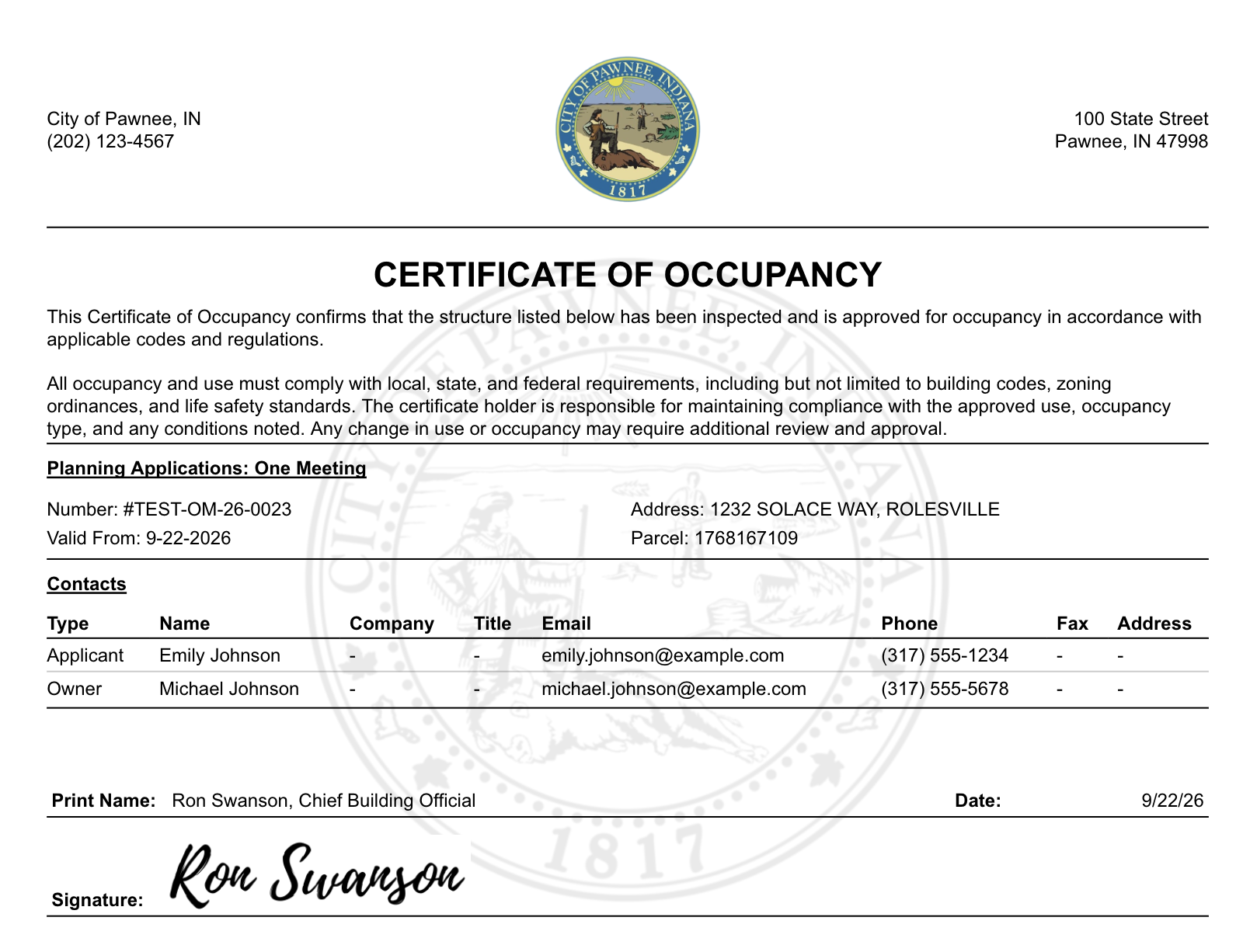
A certificate of occupancy is more than a general sign-off documenting that construction is complete. It outlines which building or portion of a building the certificate covers, and often how the space can be used, which code governs the permit, and any conditions attached.
Section 111.2 of the IBC specifies the information the certificate must contain. This often includes:
What the certificate covers
- Building permit number
- Address of the building or structure
- Name and address of the owner or the owner's authorized agent
What was approved (depending on the municipality)
- Building's use and occupancy
- Type of construction
- Design occupant load
- Where an automatic sprinkler system is provided, whether that system is required
Who approved it, and under what authority
- Edition of the code under which the permit was issued
- Statement that the covered portion was inspected for compliance with the code
- Building official's name
- Any special stipulations or conditions of the building permit
The information included on a CO comes from several departments, and much of it isn't available on the project site. The building department holds some of the details, but fire, engineering, and others often have to review and contribute to the final record. Assembling and verifying these approvals takes coordination, and can take longer than the final inspection itself.
When a Certificate of Occupancy Is Required
Buildings often need a CO for new construction, but the ultimate trigger in the code is occupancy itself. IBC Section 111.1 (Use and Occupancy) provides that a building or structure cannot be used or occupied, and no change in the existing occupancy classification can be made, until the building official has issued a CO.
New construction and first occupancy
A newly constructed building requires a certificate because it is being occupied for the first time. The certificate is issued after inspection, once the building official inspects the building and finds no violations of the code or other laws.
A change of occupancy classification
Occupancy classification is the code category that describes how a building is used. IBC Section 302.1 (Occupancy Classification) sorts structures into groups based on the nature of the hazards and risks to occupants associated with the intended purpose of the building. Converting a retail space into a restaurant changes its classification and the code requirements that apply, even when no physical alterations are made. Under Section 111.1, a new certificate is required before the new use can begin.
This is narrower than it sounds. A change of tenant (like one retail store replacing another) does not trigger a new certificate when the occupancy group stays the same. The requirement also applies to a building or portion thereof, so it reaches only the space whose classification changed, not the whole structure.
Work That Doesn't Require a Certificate
There are exceptions. The International Building Code does not require a CO for work that is exempt from permitting under Section 105.2, such as painting, tiling, carpeting and cabinets, certain small detached accessory structures, qualifying fences, and some minor electrical, mechanical and plumbing repairs.
Which code applies
Three codes cover certificates of occupancy; which one governs a project depends on the project itself.
Most commercial and multifamily projects fall under the International Building Code. Detached one- and two-family homes and townhouses up to three stories, however, are covered by the International Residential Code (Section R110).
Work on an existing building can bring in the International Existing Building Code.
Local Amendments Change What the Code Requires
These international codes set the model requirements for certificates of occupancy, but states and local governments can change requirements when they adopt the code.
Minnesota, for example, replaces the IBC's existing-building chapter with its own Building Conservation Code. Georgia makes the IEBC optional unless a local government adopts it.
Municipalities and counties can then amend Section 111 on top of that. Some remove requirements, treating an approved final inspection on the building permit as the certificate of occupancy for one- and two-family dwellings. Others add steps the model code doesn't contain. San Joaquin County, California requires permit holders to obtain approvals from every agency listed on the county's CO routing form before they can even request a final inspection.
These are deliberate local choices, and they mean contractors working across jurisdictions encounter different CO requirements from one project to the next.
Certificates of Completion
Some jurisdictions issue a certificate of completion for permitted work that doesn't create a new occupancy. The Florida Building Code, for example, uses it as proof that a structure or system is complete and, for certain permit types, released for use or connection to utilities. It does not authorize anyone to occupy the building. A shell building may receive a certificate of completion once its core and exterior are finished, but the tenant space still needs a CO after interior build-out. Alterations, reroofs, and system replacements in an already-occupied building are often closed out the same way, since the existing occupancy doesn't change.
How to Get a Certificate of Occupancy
The specific steps vary by jurisdiction, but the sequence follows the same shape almost everywhere.
First, permitted work has to be complete, or complete for the portion of the building being occupied. The permit holder then notifies the building department that the work is ready and requests a final inspection. Any other approvals the jurisdiction requires have to be in hand. For example, all reviews from fire, health, engineering, and water have to be complete. In some jurisdictions, a routing form has to be fully signed before a final inspection can be scheduled. The building official then inspects the site, and if no violations of the code or other laws the department enforces are found, the certificate is issued.
Two things determine how much work this is in practice. The first is how many departments hold sign-off, since each one involves a separate request and a separate wait time. The second is whether the jurisdiction has amended Section 111, which can add steps or remove the CO requirement entirely for some project types.
How Long Does a Certificate of Occupancy Take?
The model code sets no deadline. Section 111 states that the building official can issue the CO after inspecting and finding no violations, without attaching a specific timeframe to either step. The practical timeline comes down to scheduling availability, how many departments have to sign off, and whether corrections are required after the final inspection.
Where no statutory deadline applies, timing depends largely on the jurisdiction. The fastest way to get an accurate timeframe is to ask the building department for its current lead time between a final inspection request and certificate issuance.
A Certificate of Occupancy Isn't Always Final
Final approval isn't always the only path to occupancy.
When a building is safe to use but some permitted work remains, the building official can allow occupancy through a temporary certificate of occupancy (TCO). Section 111.3 of the IBC allows a TCO before all work covered by the permit is complete, as long as the portion being occupied can be used safely. The building official determines how long it stays valid.
The same code section gives the building official authority to revoke a certificate. Under Section 111.4, a certificate can be suspended or revoked in writing if it was issued in error, if it was issued based on incorrect information, or if the building or structure is found to violate the code or another applicable local ordinance.
Both provisions mean the process isn't finished once a building is in use. With a TCO, the department still has to track its expiration and any outstanding work, leaving an ongoing tracking responsibility even after occupancy has begun. If that follow-up lives in a spreadsheet, calendar reminder, or paper file, an expiring TCO can become an administrative blind spot.
A Certificate of Occupancy Date Matters Decades After the Work Is Done
A certificate of occupancy matters long after construction ends. Once a final CO is issued, its date becomes part of the building's permanent record, and other requirements get measured from it.
Under Florida Statutes § 553.899, for example, residential condominium and cooperative buildings of three or more habitable stories must undergo a structural milestone inspection by December 31 of the year the building reaches 30 years of age, measured from the date the CO was issued, and every 10 years thereafter. Local enforcement agencies can require the first inspection at 25 years based on local circumstances, including proximity to salt water. If the original CO date isn't available, officials may use the date of occupancy evidenced in other records maintained by the local building official.
Long-term access to CO records is a practical problem, not a filing question. A title company, insurer, property owner, or government agency may need to establish a building's occupancy date decades after construction ends. When those records sit in paper files or systems that no longer connect with one another, producing and verifying a decades-old certificate can become a project of its own.
States Are Putting Deadlines on the Final Approvals Before a Certificate of Occupancy
The certificate of occupancy is a longstanding part of the building process, but the timeline to final approval is receiving new legislative attention. States looking to speed up housing production and make permitting timelines more predictable are putting statutory deadlines around the inspections and approvals at the end of the process. For building departments, that means the coordination behind a CO, like gathering sign-offs from fire, engineering, and others, now runs against a clock with legal consequences.
The deadlines take different forms
Florida put a deadline on the certificate itself, within its private provider process. Under Florida Statutes § 553.791(16), a local building official has 10 business days after receiving a request for a certificate of occupancy, along with the private provider's certificate of compliance, all other required government approvals, and payment of outstanding fees, to issue the certificate or notify the applicant of incomplete forms or documents. For single-family and two-family dwellings, the window is two business days. If a department misses it, the request is automatically granted and deemed issued the next business day. HB 803, effective July 1, 2026, also narrowed what the official may review at this stage to completeness of forms and documents.
California put a clock on the inspection itself. Under Assembly Bill 1308, effective January 1, 2026, building departments must inspect within 10 business days of receiving notice that permitted work is complete. The requirement covers new residential projects of 10 or fewer units up to 40 feet tall, and additions to smaller residential buildings. Missing the deadline is a violation of the state's Housing Accountability Act.
Texas went further and moved the ownership of the work. House Bill 14, which added Chapter 247 to the Local Government Code in September 2023, allows a qualified third party to conduct a required development inspection when the regulatory authority hasn't conducted it by the 15th day after the deadline set elsewhere in state law.
A statutory deadline doesn't create more capacity
These laws make approval timelines more predictable for applicants, but they can also create an operational challenge for building departments.
A statutory deadline doesn't come with additional inspectors or fewer applications. Staff still have to schedule inspections, document results, track corrections, and move projects toward approval within the required timeframe. A building official can want predictable timelines and still have no way to hit them with the staff on hand.
Potential delays are not just the result of inspection time, though. Some come from not knowing which approvals are still outstanding and tracking down who has the right file. This is a records and visibility problem more than anything.
Certificate of Occupancy Checklist
The final steps toward occupancy vary by jurisdiction, but knowing what still needs to happen, who needs to approve what, and how that progress is being tracked can make the process easier on both sides of the counter.
If you're waiting on a certificate of occupancy:
- Confirm which departments hold sign-off in your jurisdiction besides building. Fire, health, engineering, and water often each have their own reviews.
- If you're converting a space to a different use, confirm whether the change moves it to a new occupancy group, since that triggers a new certificate even without physical alterations.
- Ask whether a temporary certificate is available for the completed portion, and what conditions would attach.
- Check whether your state has an inspection deadline on the books and what recourse it gives you.
If your department issues certificates of occupancy:
- Publish the required approvals and current inspection lead times somewhere applicants can find them without calling the department.
- Track every temporary certificate alongside its expiration date and outstanding conditions, so follow-up doesn't depend on a separate spreadsheet or reminder.
- Digitize historical certificates so decades-old occupancy records can be retrieved when owners, insurers, or title companies need them.
- Measure the time between a final inspection request and certificate issuance, so you can see where projects wait after construction is otherwise complete.
How GovWell Brings CO Approvals Onto One Record
Many of the challenges for building departments around certificates of occupancy come down to coordination. A final certificate can depend on multiple approvals, inspections, open conditions, and handoffs, all of which need to be tracked before occupancy is approved. GovWell brings that work into one permitting workflow:
- Required approvals in one place. Building, fire, engineering, and other required sign-offs are routed on the same permit record, so it's clear what's complete and what's still outstanding.
- AI plan review and field inspections. Staff review plans and record inspection results in the same system that carries the permit to final approval with GovWell's built-in plan review product. AI AutoCheck automatically flags common issues and errors based on local code.
- Status visibility for applicants and contractors. Applicants can see where their permit stands and what remains outstanding without calling the department for an update.
- Conditions and expirations tracked on the record. Temporary certificates, their expiration dates, and outstanding conditions stay attached to the permit rather than a separate spreadsheet.
- Historical records that can be retrieved. Certificates stay searchable, so an occupancy date can be produced years later when an owner, insurer, or title company asks for it.
- Configurable to local requirements. Workflows reflect a jurisdiction's own requirements and amendments to Section 111 rather than forcing every department into the same process.
Today GovWell works with hundreds of municipalities and counties in over 40 states. Communities using GovWell have cut permit and license processing times by up to 95%.
GovWell is purpose-built for local governments and configured around the processes of each community it works with. Whether your department is adapting to a new state inspection deadline or working to make the path from final inspection to occupancy more predictable, our team partners with you from procurement onward, configuring the platform to your process and staying with you even as it changes.